The Food for Life Foundation is launching a new programme for secondary school students in response to recent changes in the Public Education Act. Under this programme, the Foundation will offer young people who are required by law to complete a certain number of hours of community service (min. 50 hours) as a condition for taking their school-leaving exams the opportunity to do so.
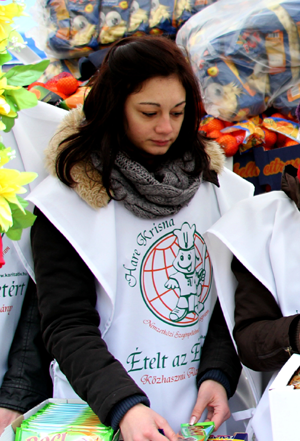 In developing our programme, we took into account the legislation in force and sought to draw on the experience available on the subject of school volunteering and community service.
The Food for Life Foundation has been providing services to groups of people in need since 1999. Over the years, our activities have become more complex and diverse, providing charitable assistance to an increasing number of groups (homeless people, large families, children in care, etc.). Our wide range of activities allows our students to get involved in a variety of activities and to gain as much experience as possible. Since our beginnings, we have worked with a large number of volunteers, so we have many years of experience in hosting volunteers and working with young people, and we are keen to put our knowledge to good use for the benefit of young people in public education. Our programme aims to provide a practical knowledge and a way of looking at things that will, in the longer term, help young people to become sensitive, active, committed and capable citizens who are able to take action in the face of social problems.
The process of performing community service:
There are two ways to serve the community at our Foundation:
1. Individual/small group (max. 3 persons)
2. In a group project
In both cases, the young people's activities are coordinated by the „field guide”, the Foundation's social worker, who discusses what they have seen and experienced, and liaises with the educational institution and individual teachers.
In both cases, the time frames can be flexibly adapted according to needs.
1. Community service for an individual or a small group of students (max. 3 persons):
- The students who come in this way learn about and take on tasks in different areas of the Foundation's daily work (administrative work for a set number of hours, kitchen preparation, purchasing goods, distributing food, putting together parcels, etc.).
- The first session will be spent getting to know the work of the Foundation. During this time, the participants - the fieldworker and the students - get to know each other and plan the rest of the exercise (who will do what when, where they will go, etc.), and then get to know the Foundation staff with whom they will work during the exercise.
- A student may, if suitably qualified, be given permanent responsibilities of their own (e.g. recording incoming food parcel requests, assembling and labelling parcels, etc.)
- At the end of each service session, the young person has the opportunity to discuss what they have seen with the field teacher, ask questions, share their experiences and comments.
- The end of the exercise: a joint evaluation of the experience, the field teacher prepares the evaluation for the school, discusses it with the young person and his/her teacher.
2. Implement a group project:
For students in groups, community service involves the organisation and joint implementation of a specific project or an element of a Foundation's flagship food distribution programme.
The Food for Life Foundation's model community service project for high school students:
Group projects can take two forms:
A. The students independently develop and implement a cultural/leisure programme for the Foundation's clients in connection with a major holiday or special event (e.g. organising a children's day out with a cookout, organising a programme for children in care homes, large families during school holidays).
B. Students will be involved in the organisation and implementation of one of the Foundation's priority food distribution activities (e.g. Christmas food distribution at Blaha Lujza Square). In this case, the framework is already in place, the young people - with the help of the field guide, of course - have to fit into an existing project structure, find their place and role.
In both types of project, students can learn how to organise and run a charity event. Every step of the project is planned and carried out with them. They can then apply this knowledge in their own communities.
The structure of group programmes:
Day 1 - Full-day group training (7 hours in total)
0 9.30 - 13.00 Getting to know the Foundation and each other (3 hours + 15 minutes break twice):
- Getting to know the work of the Foundation with the help of the field guide (How does a charity work? Who does it help? Why is it important to help? How do we do it? What is the speciality of the Food for Life Foundation?)
- Getting to know each other and planning takes the form of a one-to-one interactive discussion, with a tour and games, during which participants get to know each other. The field guide will then assess the students, their interests and motivation, and together with the young people and the accompanying teacher, they will develop a plan for the placement (the basic framework will of course have been agreed with the sending institution beforehand)
13.00 - 14.00 Lunch break - students will be served a menu cooked for the day's meal
14.00 - 17.00 Working out the details of the action - group work with students and teacher (3 hours):
a. Who is the target group?
The target group may be clients of institutions with which the Foundation is in contact, i.e:
- III. district. CSSK clients with large families
- District VII. CSSK clients with large families
- Residents of Bokréta Children's Home
- People living in the BMSZKI Family Transition Shelter
- Institute for Special Education and Development (children with disabilities and their families)
- BMSZKI White Köz Daytime shelter (homeless people)
b. Exactly when, where and what kind of programme will be organised?
c. What resources are needed to run the programme and where can they be found?
d. What are the necessary steps and tasks in the organisation?
e. Who does what?
After that, specific organisational tasks will be carried out according to the schedule and the distribution of tasks planned together during the training (e.g. contacting social institutions, organising and carrying out fundraising activities, promoting the programme, preparing and carrying out food distribution, etc.)
Last session: evaluation of the implemented programme, summarising experiences and lessons learned with the field guide and the teacher (2 hours)
For details of the programmes, please contact the Foundation's main telephone number or the following contact details:
Éva Várallyay - 06-30-684-6861 - [email protected]