

The Krishna Centre in Mumbai provides lunch for thousands of children every day. According to the organisers, the secret ingredient in the recipes is love, devotion and compassion, which gives the food an unparalleled taste of purity. The distribution of this spiritual nourishment is an effort to help victims of exploitation around the world, and thus to bring balance to the world's food supply.
Although the Food for Life programme dates back only to the early 1970s, it has in fact institutionalised an ancient Eastern custom. Since then, it has provided the largest number of poor people in India, not only with fresh hot meals, but also with hospital care in some towns, education, drinking water, trees and even protection of the sacred cow.
In the ancient Indian tradition, it has always been the responsibility of families to feed all those sections of society - pilgrims, spiritual teachers and the poor - who did not earn a living by bread-winning. As long as this custom was alive, there were no hungry people in the country. The local society, the small communities, left virtually no room for squalor and impoverishment, despite the fact that life and its necessities were conceived as basically simpler than in any of the Western countries. The situation in the country changed a lot after colonialism - social divisions and differences were also exacerbated by the struggle for property. In 1972, for example, the founder of the International Organisation of Krishna Consciousness, Srila Prabhupada, noticed Bengali children scavenging for food in garbage. Jaiyapataka Swami, the then head of the Krishna centre that was being built in Mayapura, recalls the incident: „I remember, just the day after we moved into the first building that was completed, Srila Prabhupada was sitting in his room on the second floor. That day we had just arranged a big feast for a few hundred guests. After the meal, banana leaves used as plates were thrown into a large garbage bin next to the main building. After a while there was a big commotion downstairs, so Srila Prabhupada looked out of the window. He could see children from the village standing in the garbage and licking the crumbs off the leaves. Prabhupada's eyes welled up with tears and he said, ’How hungry these people are - they have to struggle so much to get some scraps. This is God's house, Krishna's house - whoever comes here, to the Father's house, must get some food.’
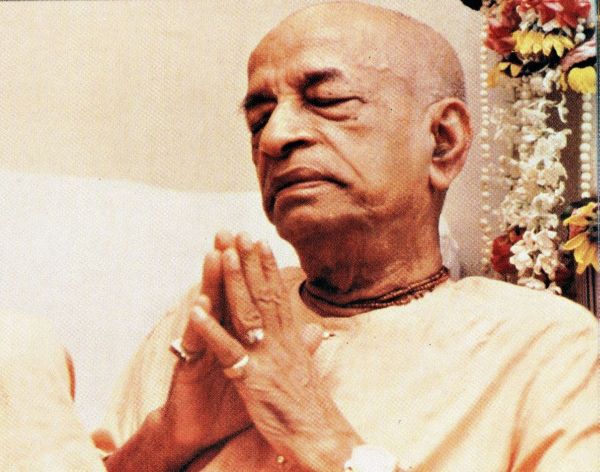
Prabhupada asked his disciples that wherever there was a Krishna temple, there should be no starving person within a radius of ten kilometres. The first Food for Life centre was therefore opened in Mayapur, West Bengal, the very site of the event. Villagers from miles around came to the food distributions, where they received fresh, hot, nutritious meals. „That's when we decided to build a huge canteen where up to 1,500 people can have lunch at the same time.” - says Jaiyapataka Swami - „Since then, food distribution has continued on a regular basis. In an average month we feed around 20,000 people, but on special holidays we can eat up to 15,000 meals in a day.” In addition, thanks to government and NGO partnerships, nearly 2,000 mothers with many children are also fed.
In Mumbai, one of India's most populous cities, the Temple of Krishna in Juhu is organising the distribution of more than a million bowls of food and 600,000 cups of halava (Indian sweets) in one year. Here, too, they mainly support the underprivileged through various events, temple celebrations and other activities. They do not receive ordinary food, but prasada - a vegetarian meal prepared with great dedication by the chef and sanctified at the altar, which not only satisfies hunger but also brings spiritual growth.
Mumbai also has a special child feeding programme, as it has the highest rate of child deaths from hunger, ahead of Congo, Nigeria and Pakistan. The last survey measuring child hunger was conducted in 2005 and found that 46% of children, or 31 million children under 3 years of age, were undernourished - a figure that represents almost the entire population of Canada. The country's Prime Minister, Manmohan Singh, himself drew attention to this in a public speech: „The problem of malnutrition is a national disgrace. Although the GDP indicator is rising at an impressive rate, the level of malnutrition in the country is unacceptably high.” In 2011, the government spent $11 billion on programmes that provided food for people officially considered poor, and under the auspices of the Mid Day Meal Scheme, this is still going on today.
The Krishna devotees of Mumbai have joined the government's programme and have rightly named the initiative „Annamrita” or 'Nectar Grain', as they use 4.5 tonnes of rice in their kitchens every day. Radha Krishna Das, Programme Director, focuses on feeding children, as the opportunity of a good lunch attracts thousands of children to school, providing them not only with food but also with education, which is a big word in today's India. „The majority of the country's population cannot afford a decent meal a day. menu, unable to escape the vicious circle of poverty and illiteracy. From ’Annamrita programme’, preparing sanctified food in modern kitchens with a spiritual environment food nourishes the mind, body and soul. The secret ingredient of food is love, love devotion and compassion that gives the food an unparalleled taste of purity.” - states the Director.
One victim of malnutrition was three-year-old Rashid Ahmed. He was taken to the famous New St Stephen's Hospital in Delhi for treatment, where it was later determined that his death was caused by malaria. Both his mother, Nazia, and his brother claim that malnutrition was the real cause. They were a poverty-stricken family and could not afford food. Dr Gauray, who was working on the day of the child's death and was a witness to the event, said: „He died of starvation. He was so weak and malnourished that he would have died as soon as he caught any disease, whether it was malaria, diarrhoea or anything else.”
In addition to the cities mentioned above, the Krishna Consciousness Movement also cares for children in a small town not far from New Delhi, Vrindavan. Over the past 22 years, the Meals for Life programme here has greatly reduced child deaths by distributing food to children living on the streets. But this is not achieved through food distribution alone. Rupa Ragunatha das, the programme's local manager, roams the streets of the city, reaching out to children who are sick and/or living in poor families and spend much of their time begging and loitering. If the family background confirms the child's situation, Meals for Life takes them to a school run by the programme, where it provides them with clothing, school supplies and a generous meal several times a day during breaks in the school day, in addition to education.
Education here is not just about acquiring basic or compulsory literacy and knowledge. As Vrindavan is a special holy place for Hindus, students in the local school also start the day with temple rituals, thus also learning the spiritual tradition. The curriculum also combines secular and ancient religious traditions, as students learn to use computers and read masterpieces of world literature in the school library, while also gaining a lifelong spiritual perspective from teachers who follow strict religious principles.
The local programme director has expanded the foundation's scope of activities enormously, as it raises the standard of living of the local population in many areas, from adult education and self-help programmes, to orphanages, water purification, health care and the maintenance of a cow sanctuary. The successes of the complex social network built up over decades have led to requests for help from public authorities.
Looking at global food distribution, there are huge inequalities. According to the UN Food and Agriculture Organisation, there is enough food for 4.7 billion people in the world, yet 460 million people on the planet are hungry. In Africa, millions are on the brink of starvation, while in the Americas, granaries are overflowing with surplus. Priyavrata Das, head of Food for Life Global, says the food distribution programme is tackling these very inequalities: „The goal of the Krishna Consciousness Movement is defined by Srila Prabhupada as the balance of values to achieve unity and peace in the world. This concept is also the main driving force behind the Food for Life Programme, which seeks to help the victims of exploitation by distributing nutritious, sanctified spiritual food and thereby balance values.”
But Priyavrata says this also requires change at the level of the individual. „Spiritually, I see that the world will continue to have huge inequalities in food distribution as long as we think ’everything I have is for my enjoyment’. This misconception is deeply ingrained in all of us and it perpetuates all the inequality we see around us. This is why the rich get richer and the poor get poorer.”
The humanitarian programme now fights inequality in more than sixty countries around the world and has grown over the years to become the world's largest vegetarian food distribution service. In our country, food distribution has been going on since the early nineties. But in addition to the everyday work of feeding the disadvantaged, there are occasional activities linked to religious holidays and festivals. One such event was the food distribution at the Chariot Festival in mid-summer, where anyone of any age, gender, ethnicity or wealth could partake of the traditional Indian menu, which was also a spiritual meal offered to God. According to the ancient Book of Vedas, the sharing of sacred food brings peace and prosperity to the whole world - perhaps one step closer to this for humanity.